Ledger Live: Wallet Recovery Mechanisms
Ledger Live wallet recovery mechanisms determine how users restore access to their accounts across various scenarios that affect device availability. The Ledger Live recovery infrastructure builds on the underlying cryptographic foundation that the hardware wallet establishes during initial setup, with the recovery capabilities being one of the most important aspects of the broader platform since they determine whether users can actually regain access after device loss or damage.
Understanding recovery mechanisms matters before recovery becomes necessary rather than after problems develop. The Ledger Live platform supports recovery through several different paths, with each path having specific characteristics that affect when it applies and what users actually need to complete recovery successfully. Users who understand recovery before needing it position themselves to handle recovery situations confidently rather than panicking when devices fail or get lost.
This overview examines Ledger Live wallet recovery mechanisms across the various paths the platform supports. The Ledger Live recovery functionality represents architectural choices that balance security against practical recovery needs, with the mechanisms addressing the various scenarios users actually face throughout the device's operational life including loss, damage, replacement, and various other situations affecting wallet access.
Ledger Live Recovery Foundation
Ledger Live recovery foundation establishes the cryptographic principles that all recovery mechanisms build upon. Understanding the foundation clarifies why recovery works the way it does.
Deterministic Key Derivation
Deterministic key derivation underlies all Ledger Live wallet recovery mechanisms through the relationship between recovery phrases and derived accounts. The Ledger Live application generates accounts through hierarchical deterministic algorithms that produce the same accounts whenever the same recovery phrase processes through the same derivation paths. The deterministic property means recovery phrases functionally represent all derived accounts rather than each account requiring separate backup, with the single backup of the recovery phrase covering all current and future accounts derived from it. The Ledger Live recovery mechanisms exploit this deterministic property to restore complete account access from just the recovery phrase, with the cryptographic mathematics ensuring perfect reproduction of original accounts regardless of which specific device performs the derivation.
Recovery Phrase as Master Backup
Recovery phrase as master backup positions the 24-word phrase as the single critical element that controls all Ledger Live wallet recovery. The Ledger Live application generates recovery phrases during initial device setup, with the phrase being the master cryptographic key from which all derived accounts ultimately come. The phrase functions as a single point of recovery for all current and future accounts, eliminating the need for separate backups of each account or each blockchain. Users maintaining proper recovery phrase backups can recover access regardless of which devices they had or what specific accounts existed at any time, with the phrase being timeless rather than tied to specific device generations. The master backup role makes recovery phrase protection the most important security responsibility users carry across their entire crypto activity.
Hardware-Bound Operations Independence
Hardware-bound operations independence in Ledger Live wallet recovery means recovery doesn't require any specific original hardware. The Ledger Live recovery process works across different Ledger devices, with replacement devices producing the same accounts as original devices when initialized with the same recovery phrase. The hardware independence matters because devices sometimes become unavailable through loss, damage, theft, or various other circumstances that make using specific original devices impossible. The Ledger Live wallet recovery mechanisms ensure that hardware loss doesn't mean account loss provided users maintained their recovery phrase backups appropriately. Users replacing devices for any reason can restore the same accounts through the new device, with the operational continuity being a fundamental design property rather than just a convenient feature.
| Ledger Live Recovery Mechanism | When Applies | Requirements |
|---|---|---|
| Recovery phrase entry | Device loss or damage | Original phrase backup |
| New device initialization | Replacement scenarios | New device plus phrase |
| Same device restoration | After device wipe | Device plus phrase |
| Ledger Recover service | Subscription users | Provider cooperation |
| Multiple device backup | Pre-arranged redundancy | Multiple initialized devices |
| Account recreation | Configuration loss | Accounts derive again |
| Custom token re-addition | After reinstallation | Manual re-addition |
| Settings reconfiguration | After reinstallation | Manual or sync |
Ledger Live Standard Recovery Process
Ledger Live standard recovery process handles the most common recovery scenarios through straightforward workflows. Understanding the standard process clarifies typical recovery patterns.
Replacement Device Initialization
Replacement device initialization in Ledger Live wallet recovery happens when users start with new hardware to restore existing accounts. The Ledger Live application detects new uninitialized devices during connection, with the setup flow including the option to restore from an existing recovery phrase rather than generating fresh accounts. Users selecting the recovery path then enter their existing 24-word phrase through the new device's physical controls, with the entry happening on the hardware rather than through the connected computer to maintain the security model. The Ledger Live replacement device initialization completes the cryptographic setup that enables all subsequent operations, with the new device then functioning identically to how the original device functioned before its loss or damage created the need for replacement.
Recovery Phrase Entry Workflow
Recovery phrase entry workflow during Ledger Live wallet recovery requires careful entry of all 24 words in correct order. The Ledger Live recovery process guides users through entering each word, with the device confirming each entry as users proceed through the sequence. The on-device entry uses the device's physical controls including buttons or touchscreen depending on the specific device model. The entry process includes word validation that catches typos and recognition of incorrect words from the standard BIP39 word list that recovery phrases use. The Ledger Live workflow protects against various entry errors through the structured input process, with successful completion producing the deterministic regeneration of all accounts that the original recovery phrase controlled across the broader account collection users maintained.
Account Re-Discovery
Account re-discovery in Ledger Live wallet recovery happens after device initialization completes successfully. The Ledger Live application doesn't automatically know which specific accounts existed on the previous device, with users adding accounts back through the standard account creation workflow that derives the same addresses given the same recovery phrase. The Ledger Live account re-discovery process treats account configuration as separate from cryptographic backup, with the deterministic derivation ensuring that adding accounts back produces the same addresses while the user-level configuration like custom names and organizational structure being recreated manually. Some users find this process slightly inconvenient compared to fully automated restoration, but it reflects the architectural choice to keep cryptographic backup separate from operational configuration in ways that simplify the underlying security model.
Ledger Live Recovery Service Path
Ledger Live recovery service path provides an alternative for users who specifically subscribed to the optional service. Understanding the service path clarifies the institutional recovery model.
Ledger Recover Subscription Activation
Ledger Recover subscription activation in Ledger Live wallet recovery applies only to users who opted into the service. The Ledger Live Recover subscription splits recovery phrases into encrypted shards distributed across multiple independent providers during the initial subscription setup, with the providers then holding shards that can be combined to reconstruct phrases during recovery scenarios. The subscription activation involves identity verification through the providers' KYC procedures, with the verification creating the identity baseline that recovery requests check against. The Ledger Live wallet recovery through Ledger Recover only works for subscribers, with non-subscribers using only the traditional recovery phrase mechanisms regardless of any other circumstances affecting their devices.
Identity Verification During Recovery
Identity verification during recovery through the Ledger Recover service requires users to authenticate with the providers. The Ledger Live recovery service involves users completing identity verification when they actually need to recover, with the providers checking the requesting party against the identity baseline established during initial subscription. The verification happens independently across providers rather than relying on a single authentication, with the multiple verification steps protecting against scenarios where one provider's verification process gets compromised. Successful verification across providers triggers the next phase of recovery, with failures preventing recovery completion regardless of other factors. The identity verification model represents the fundamental departure from purely cryptographic recovery toward an institutional verification approach that the Ledger Recover service implements.
Threshold Shard Reconstruction
Threshold shard reconstruction during Ledger Live wallet recovery through the Recover service combines multiple shards back into the original phrase. The Ledger Recover service requires a threshold number of providers to cooperate, with the cooperation combined with successful identity verification triggering the actual reconstruction process. The reconstruction produces the original recovery phrase that the user can then enter into a replacement device through the standard recovery workflow. The Ledger Live wallet recovery through Recover involves more steps than traditional recovery from offline backup, reflecting the additional verification that institutional recovery includes for security purposes. Users completing recovery through Recover service get equivalent account restoration to traditional recovery, with the differences being in the recovery process rather than the recovery outcome.
Ledger Live Recovery Considerations
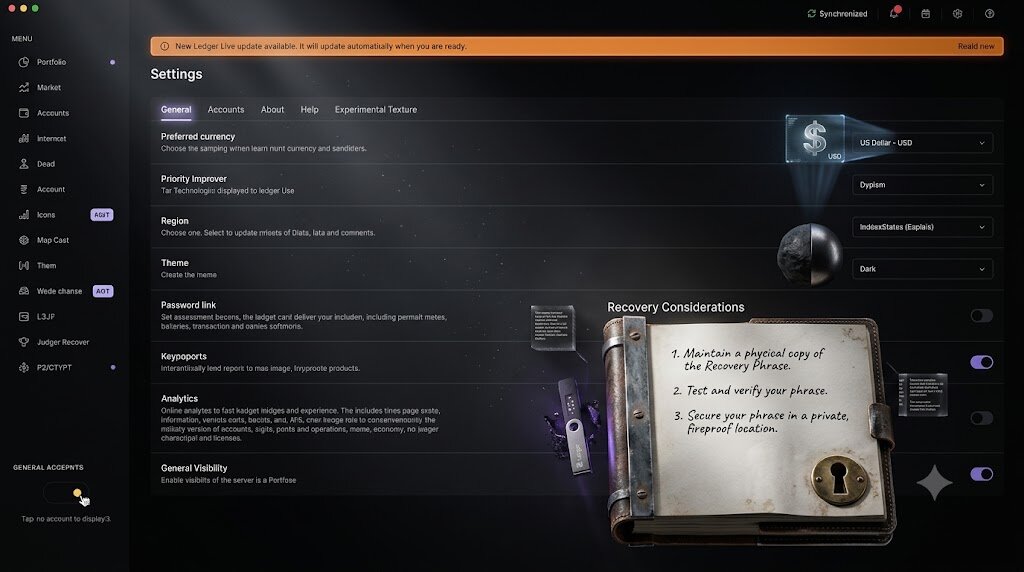
Ledger Live recovery considerations affect how users approach their recovery planning and execution. Understanding considerations clarifies the practical aspects.
Recovery Phrase Storage Quality
Recovery phrase storage quality directly determines Ledger Live wallet recovery success regardless of which recovery path users employ. The Ledger Live recovery phrase backup quality affects whether users can actually complete recovery when they need to, with degraded or lost backups making recovery impossible regardless of how recovery procedures otherwise function. Quality storage involves writing the phrase clearly and accurately during initial recording, storing the recording on durable materials that resist environmental damage, and maintaining the storage in secure physical locations that prevent unauthorized access. Some users invest in metal backup plates that resist fire and water damage better than paper recordings, with the metal investment being worthwhile insurance for users with substantial holdings. The Ledger Live recovery system can only work with what users actually maintained.
Multi-Device Redundancy
Multi-device redundancy in Ledger Live wallet recovery provides operational backup beyond just recovery phrase backup. The Ledger Live application supports running multiple Ledger devices initialized with the same recovery phrase, giving users immediate access through backup devices when primary devices become unavailable. Multi-device setups eliminate the recovery phrase entry step that single-device approaches require when devices fail, with the backup device providing immediate continuation of operations rather than requiring full recovery procedures. Users with substantial holdings sometimes maintain multiple devices specifically for this redundancy, accepting the additional hardware cost as insurance against operational disruptions from device problems. The redundancy doesn't replace recovery phrase backup since multiple devices fail simultaneously in some scenarios, but it does provide additional operational resilience beyond just the ultimate phrase-based recovery option.
Recovery Practice Considerations
Recovery practice considerations in Ledger Live wallet recovery involve actually verifying that backups work as expected before emergencies require their use. Some users perform test recoveries to confirm their backup phrase entries are accurate and complete, with the testing happening through controlled procedures that don't risk current operations. The Ledger Live test recovery sometimes involves initializing a separate device with the backup phrase to verify it produces the expected accounts, then either continuing to use the additional device or wiping it after the verification. The practice approach catches potential problems with backups before emergencies create urgency, with the testing investment being worthwhile insurance for users wanting recovery confidence beyond just the assumption that proper procedures during initial backup produced functional results.
The major Ledger Live wallet recovery workflow steps include the following:
- Identifying the recovery scenario and applicable mechanism
- Locating the recovery phrase backup from secure storage
- Initializing a replacement Ledger device when needed
- Entering the 24-word phrase through device controls
- Verifying device confirmation that entry was correct
- Re-creating account configurations within Ledger Live
- Reinstalling chain-specific apps as needed
- Confirming successful access to expected accounts
Ledger Live Recovery Edge Cases
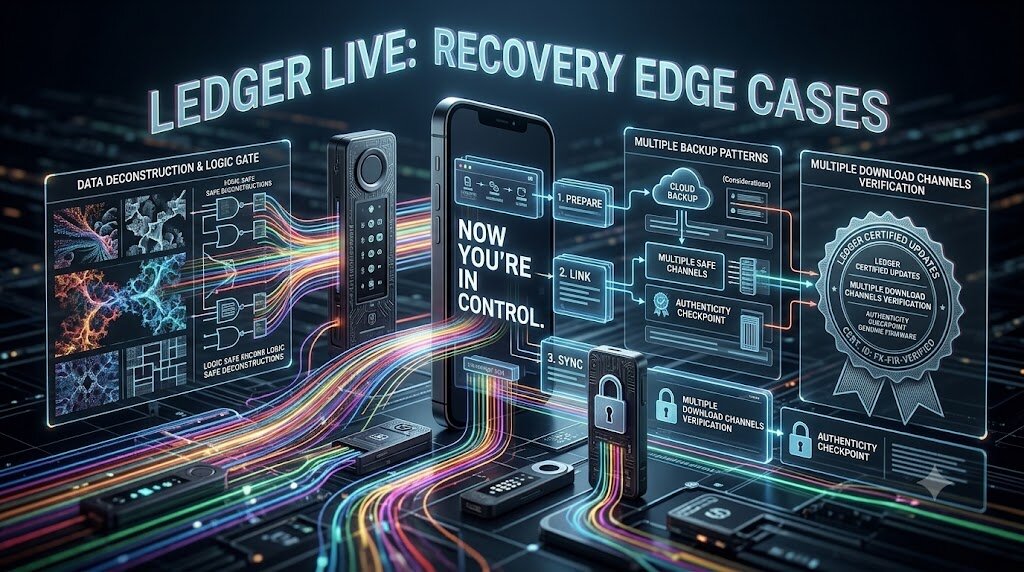
Ledger Live recovery edge cases address less common scenarios that some users encounter. Understanding edge cases clarifies recovery beyond standard situations.
Partial Recovery Phrase Loss
Partial recovery phrase loss in Ledger Live wallet recovery affects users who somehow have most but not all of their 24 words. The Ledger Live recovery cannot work with incomplete phrases, since the cryptographic derivation requires all 24 words in correct positions. Some technical recovery tools exist for scenarios with very small numbers of missing words, attempting to brute-force the missing positions through computational checking, though these approaches have limited applicability. Users facing partial loss situations typically need to consult specialized recovery services or accept that some loss might be permanent depending on how many words are missing and various other factors. The Ledger Live application itself doesn't provide partial recovery capability, since the underlying cryptography simply doesn't work with incomplete information regardless of how close to complete the information might be.
Phrase Order Confusion
Phrase order confusion during Ledger Live wallet recovery affects users uncertain about the correct sequence of their recovery phrase words. The Ledger Live recovery phrases have specific word order that the derivation algorithm depends on, with rearranged orders producing entirely different accounts rather than the original accounts. Users uncertain about exact order sometimes try multiple orderings, though the combinatorial expansion makes systematic trial impractical beyond very small uncertainty. Some users verify phrase order during initial backup through structured recording approaches that prevent later confusion, with the prevention being more practical than later recovery from order uncertainty. The Ledger Live recovery requires correct order, making careful initial recording crucial for reliable later recovery.
Old Device Recovery
Old device recovery in Ledger Live wallet recovery sometimes involves Ledger devices from earlier product generations that users want to restore. The Ledger Live application supports older Ledger devices alongside current models, with the recovery functionality working across generations because the underlying cryptographic standards remain consistent across device versions. Users with older devices recovering after periods of non-use sometimes need to update firmware or perform various other maintenance before their devices function optimally with current Ledger Live versions. The Ledger Live wallet recovery itself works on old devices, though some users find upgrading to newer devices provides better experiences than continuing to use older models that lack features newer hardware provides across the broader product range.
Common Ledger Live wallet recovery characteristics across the broader system include:
- Recovery phrase as the master backup credential
- Deterministic key derivation enabling consistent restoration
- Hardware-bound operations independence across devices
- Replacement device initialization for restoration
- Recovery phrase entry through device physical controls
- Account re-discovery through standard creation workflow
- Optional Ledger Recover service for subscribers
- Multi-device redundancy for operational continuity
- Storage quality determining recovery success
- Test recovery practices for backup verification